
Mexican American War
Peace with consequences

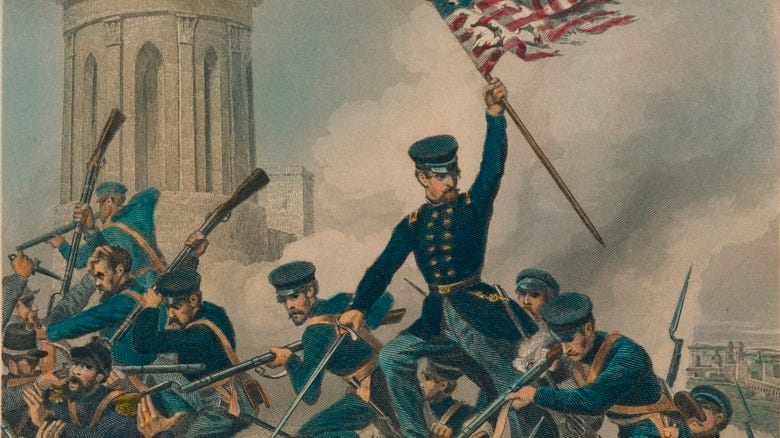
The Mexican-American War fought between 1846 and 1848, was theoretically over the border dispute with the newly acquired states of Texas and Mexico. However, this was a convenient provocation for America to expand its territory to the West Coast and take the prize of California from Mexico. In the Election of 1844, the Democrats, under Andrew Jackson's protege James Polk, ran on a platform of manifest destiny and called for incorporating Texas into the union and expanding further west to the Pacific Ocean. The Whig party, staunchly opposed to this expansion and foreseeing war with Mexico as its natural outcome, fought a losing battle. Their defeat in the election of 1844 marked the beginning of Polk's expansionist policy.
When Texas became part of the United States in 1845, the border dispute between the Republic of Texas and Mexico became the border dispute between the U.S. and Mexico. The U.S. claimed the border was the Rio Grande River, whereas Mexico claimed it was farther north, at the Nueces River. Polk wished to settle this dispute peacefully by offering to purchase the land in question along with California and all the land in between. However, Mexico had none of it and declined Polk's offer. In response, Polk sent U.S. Army soldiers to the disputed territory with orders to fire back on any Mexican movement into that disputed territory.
Of course, there was a dispute with Mexican forces, and American blood was spilled. On this basis, Polk got Congress to Declare War on Mexico in 1846. The American Army, with superior training and especially artillery, was able to defeat the Mexicans in border skirmishes after the war was officially declared. General Zachary Taylor led this relief force to the newly constructed Ft. Brown (present-day Brownsville) using light mobile "flying" artillery with a devastating effect on the Mexican Army.
Taylor then fought a series of engagements throughout northern Mexico, culminating in Battles at Monterrey and a final defeat in the North at Buena Vista in 1847. Other American forces spread west along the present-day border. They reinforced a small American force under General John Freemont that declared California for the U.S., winning small battles by San Diego and Los Angeles. Everything was going well for the U.S.; however, the northern Army could not go any further south due to the hostile terrain and the need to garrison the newly acquired lands.
General Winfield Scott, the highest-ranking U.S. military figure who wanted to leave his mark on the conflict, hatched the next phase of the war. He would invade Mexico at Vera Cruz in the southeast of the country and march overland to Mexico City, defeat the Mexican Army, and conclude peace with the concessions demanded by the Polk Administration. The campaign was not without risk, but Scott and his subordinates would take Mexico City with bold attacks and superior artillery tactics.
The Americans fought off a few attempts by Mexican troops to relieve the city, but their disorganized Army was different from the American force under Scott. The Army controlled Mexico City while peace negotiations took place. It was beneficial to be in control of the capital and make peace. In early 1848, the Treaty of Guadalupe was signed, and the Americans agreed to pay 15 million dollars to Mexico and debts owed by Americans. In return, the resulting treaty required Mexico to cede 55 percent of its territory, including California, Nevada, Utah, Colorado, New Mexico, Arizona, and a small portion of Wyoming. Mexico also relinquished all claims for Texas and recognized the Rio Grande as the southern boundary of Texas.
This conflict was a significant victory for the American Military. This battlefield victory is unquestionable. Looking at who won the peace, we can state the obvious: America gained vast territory acquisitions with parts of seven future American States and solidified Texas as a large part of American expansionism through the 19th and early 20th centuries. It's too easy to say that America won the peace with this territorial expansion, however. If we examine the impact of this peace more closely, we see the seeds of the next great conflict rise from the ashes of the Peace of Guadalupe.
The United States was a divided nation in the 1850s between free and slave states. The compromise of 1820, making a clear demarcation line between Free and Slave states, helped prevent the country from fracturing in the 1820s. Still, with this newly acquired land mostly south of that line, the free states in the North were concerned that slavery would grow, and slave states would be the majority in Congress. Instead of containing slavery, it would expand into new territories.
This issue again divided the slave vs free state Congress until a new solution was passed in 1850. The Compromise of 1850 admitted California as a free state but left open the other (still territories, not states) that could determine their future as slave or free states. A more damaging clause in this compromise was the Fugitive Slave Act. This gave southern enslavers the right to confiscate slaves who ran away to free states if the free states did not return them of their own volition. Little understood by politicians of the time, but this clause would put the nail in the coffin for the Antebellum United States. Civil War would break out with the election of Abraham Lincoln just ten years after the Compromise of 1850.
Significant victory and massive territory expansion did not fully benefit the United States. The Civil War began just 13 years after the Treaty of Hidalgo, throwing the United States into a devastating war and tearing apart the country. The War with Mexico, no doubt, hastened this war by passing the Compromise of 1850, which alleviated no one in reality. We can also mention the war was naked aggression by the United States to grab land. Civil War General and future U.S. President U.S. Grant, who fought in the war, later said, "I do not think there was ever a more wicked war than that waged by the United States on Mexico." It turned the once anti-colonial former colony into an imperialist power bent on expansion and manifest destiny.
Lastly, this war still resonates today with the border issues the United States and Mexico face. Americans scream about illegal immigrants pouring through this territory that would have been part of Mexico with only a slight twist, a fait, land the United States basically extorted from Mexico. It is better for humanity. Overall, I believe it best that America won this war and made this territory rich and fertile. However, we must remember that a peace that seems overwhelmingly favorable isn't always the case when looking back on history. The Mexican American war and peace prove this.